Yogyakarta — Indonesia’s palm oil industry faces significant challenges in sustaining productivity. Despite rising global demand for vegetable oils, productivity is constrained by ageing plantations, stagnant yields, and increasing pressures from pests and diseases.
According to 2025 data from the Directorate General of Estates under the Ministry of Agriculture, Indonesia’s total oil palm plantation area has reached 16.9 million hectares, producing 46.55 million tons of Crude Palm Oil (CPO) nationwide. This translates into an average national productivity of approximately 2.75 tons of CPO per hectare per year.
These conditions underscore the need for more strategic approaches in the palm oil industry. Growth must now focus on intensification, producing more from existing plantations rather than expanding land. Superior seed innovation, replanting programs, and enhanced research are essential to maintaining Indonesia’s competitiveness.
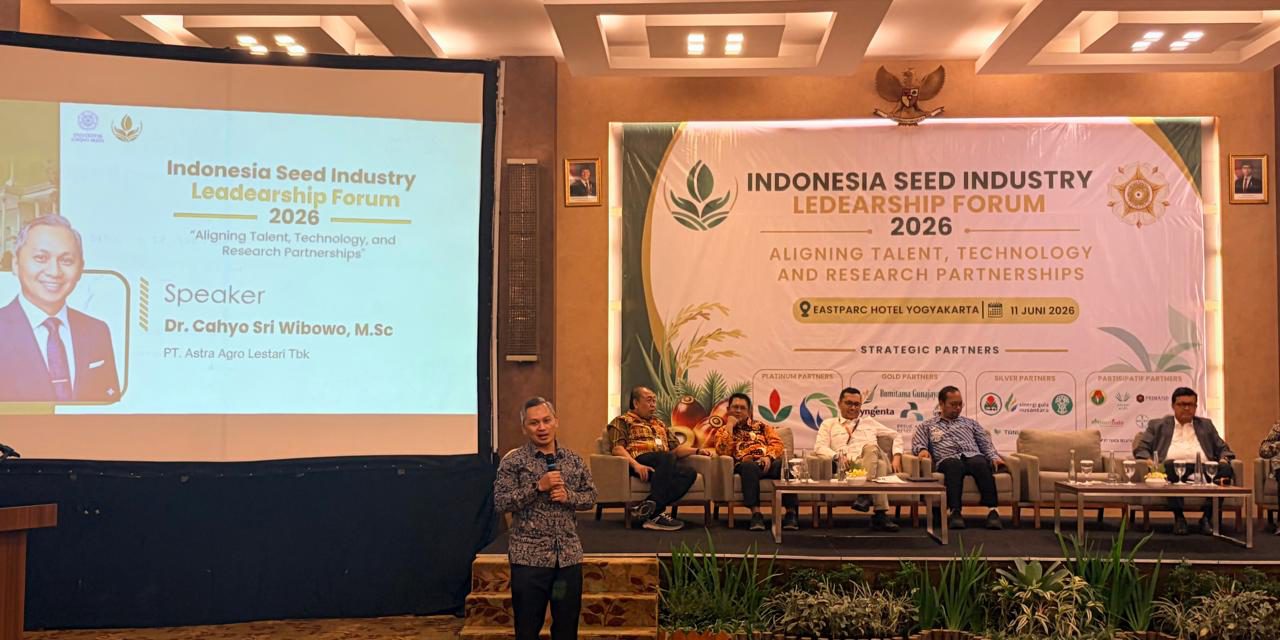
This message was among the key points delivered by PT Astra Agro Lestari Tbk during the Indonesia Seed Industry Leadership Forum 2026, organized by the Department of Agricultural Cultivation, Faculty of Agriculture, Universitas Gadjah Mada (UGM), in Yogyakarta. During the forum, Astra Agro’s Senior Vice President of Research & Development, Cahyo Sri Wibowo, participated as a panellist in the Executive Leadership Panel session titled “Talent and Technology for the Next Decade.”
For Astra Agro, seed development is crucial to addressing productivity challenges. Seeds form the foundation for long-term plantation performance. Developing superior varieties is a key strategy to increase productivity without expanding plantation areas.
“Superior seeds are the key to building a new generation of highly productive and sustainable oil palm plantations,” said Cahyo.
To achieve this, Astra Agro prioritizes research and development in its long-term strategy. The company develops superior oil palm varieties through its Research & Development center, aiming to enhance productivity and strengthen plant resilience against diseases.
In 2025, Astra Agro introduced three new superior seed varieties: DxP AAL Nirmala MRG, DxP AAL Lestari MRG, and DxP AAL Sejahtera MRG. These build on the company’s earlier varieties, AAL Nirmala, AAL Lestari, and AAL Sejahtera, launched in 2020.
These new varieties were developed to address Ganoderma, a major disease affecting oil palm plantations that disrupts growth and reduces productivity. By offering planting materials with enhanced resistance, Astra Agro aims to provide solutions better suited to current plantation conditions and industry needs.
According to Cahyo, developing superior varieties is not only about increasing production potential but also improving plant resilience, cultivation efficiency, and sustainable productivity throughout the planting cycle. This is especially important as many plantations enter the replanting phase.
Astra Agro is implementing its own replanting program as a long-term strategy to enhance productivity. Replanting allows the company to improve planting material quality, optimize cultivation systems, and use superior genetic material to establish more productive and disease-resistant plantations.
“Replanting is an opportunity to strengthen the foundation of plantation productivity. When ageing palms are replaced with superior varieties, what is renewed is not only the crop itself but also the future of the plantation. This is why the right seeds, strong research, and increasingly precise plantation management are so important,” Cahyo explained.
Astra Agro believes Indonesia’s palm oil challenges require practical, measurable innovations aligned with field realities. Developing superior varieties, implementing well-planned replanting programs, strengthening research, and fostering collaboration among industry, government, associations, and universities are essential to strengthening the seed ecosystem.
“We need to work together to build a resilient, competitive, and sustainable Indonesian seed ecosystem because sustainable seeds are the foundation of a sustainable future for the palm oil industry,” Cahyo stated.
Through these efforts, Astra Agro promotes higher productivity from existing plantations and delivers practical solutions to support a more efficient, productive, and sustainable Indonesian palm oil industry.