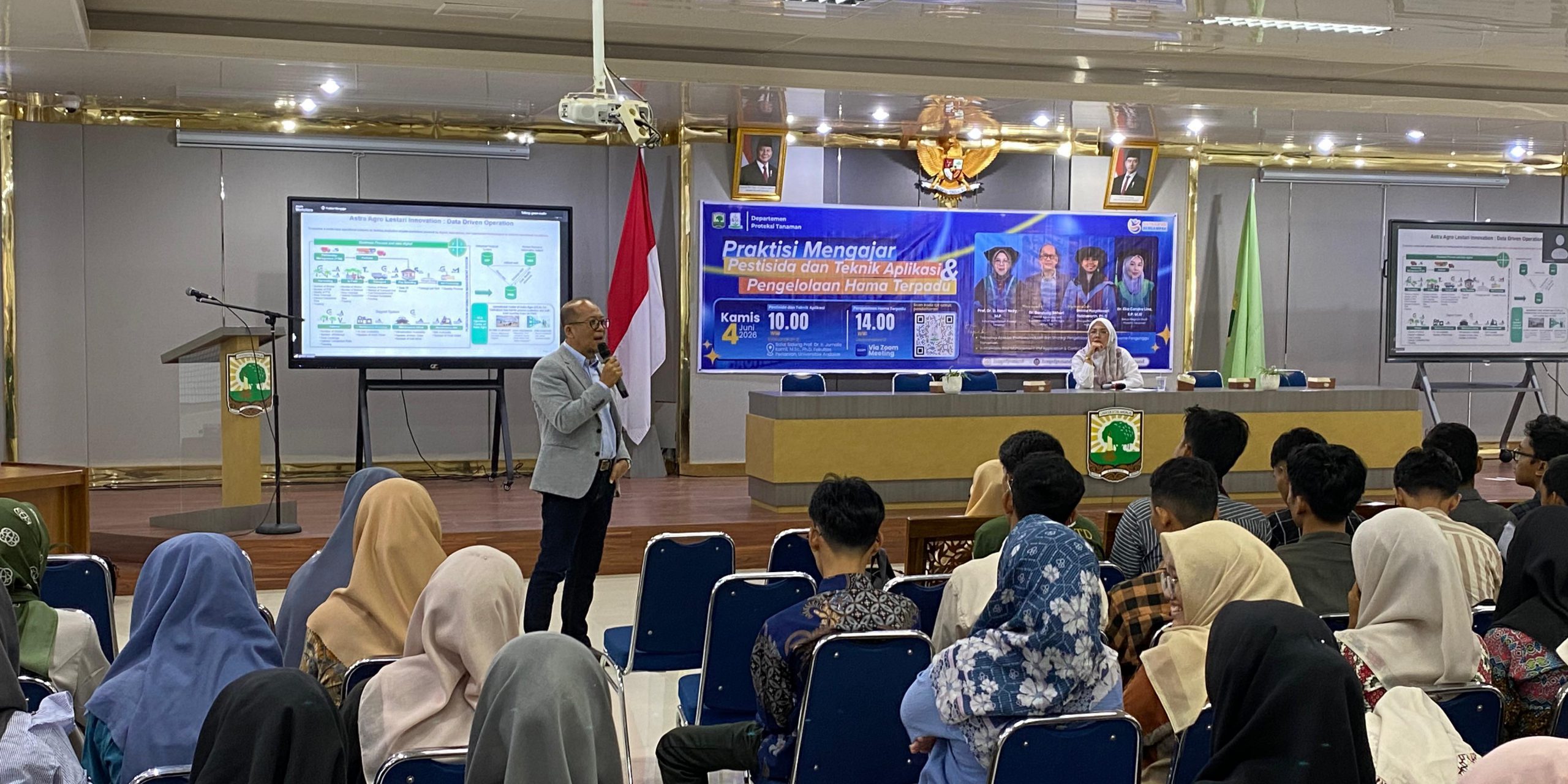
Padang, West Sumatra – PT Astra Agro Lestari Tbk shared insights on Indonesia’s palm oil industry with students from the Faculty of Agriculture at Andalas University on Thursday (June 4). As a key national commodity, palm oil requires sustainable management to address future challenges.
As keynote speaker, Astra Agro’s Director of Agronomy and Sustainability, Dr. Bandung Sahari, emphasized the need to balance economic, social, and environmental considerations in oil palm plantation management. He discussed modern, effective, and responsible approaches to pest management.
Bandung noted that Indonesia’s palm oil industry faces complex challenges. While global demand for vegetable oils rises with population growth, the industry must also improve productivity and uphold environmental and sustainability standards.
“Going forward, the challenge for the palm oil industry is to achieve high productivity while maintaining plantation ecosystems that support biodiversity. Therefore, productivity improvement must go hand in hand with sustainability principles, technological innovation, and sound environmental management,” Bandung stated.
He explained that effective pest management is essential for maintaining oil palm productivity. Modern practices now use Integrated Pest Management (IPM), which prioritizes ecosystem balance and technology over sole reliance on pesticides.
Astra Agro’s biological control strategy uses natural enemies, including predators, parasitoids, and entomopathogens, to maintain ecological balance and minimize environmental impact. The company also employs an Early Warning System for rapid, accurate pest monitoring to prevent significant crop losses.
Bandung added that effective pest management requires a thorough understanding of ecosystem conditions. Astra Agro continues to develop environmentally friendly biological methods using natural enemies and control agents.
For example, the predator insect Sycanus is used to control leaf-eating caterpillars, a major oil palm pest. This approach effectively reduces infestations and reliance on chemical pesticides.
The company also uses the fungus Metarhizium anisopliae to control rhinoceros beetles (Oryctes rhinoceros) and encourages barn owl (Tyto alba) populations to manage rats. These initiatives support ecosystem balance and reduce chemical input use.
“Our guiding principle is to keep pest populations manageable without disrupting ecological balance. This is why biodiversity conservation and biological control agents are central to our pest management strategy,” Bandung explained.
Bandung also emphasized that industry engagement with higher education is essential to connect academic knowledge with practical challenges.
“Today’s students are the future leaders of Indonesia’s plantation industry. By sharing our experiences and best practices, we aim to broaden their perspectives on productivity, innovation, and sustainability,” he said.
Meanwhile, Dr. Ir. Eka Candra Lina, S.P., M.Si., Head of the Plant Protection Study Program at the Faculty of Agriculture, Andalas University, expressed appreciation for Astra Agro’s participation in the Practitioner Teaching Program, which gives students direct exposure to industry insights and practices.
Eka noted that Astra Agro’s materials align closely with the Plant Protection Study Program’s focus, especially on environmentally friendly pest management. These methods are vital for effective crop protection and environmental sustainability.
The vision of the Plant Protection Study Program is to become a leading and distinguished academic program in education, collaborative research, and community service that supports the development of sustainable and globally competitive plant protection. Therefore, Astra Agro’s presentation on biological control, biodiversity conservation, and sustainability principles is highly relevant to the academic direction we are pursuing,” Eka said.
She added that the program offers significant value by allowing students to learn both theoretical concepts and their practical application in industry, including integrated pest management, sustainability, environmental conservation, and technology. These practices are crucial for national food security and the development of a productive, competitive, and sustainable plantation sector.
“We hope to strengthen collaboration between universities and industry to develop future professionals with strong technical skills and a deep understanding of sustainability in Indonesia’s agricultural development,” she added.
Through the Practitioner Teaching Program, Andalas University and Astra Agro demonstrate that collaboration between academia and industry is essential for preparing future generations to advance Indonesia’s palm oil industry productively, innovatively, and sustainably.
In line with the spirit of ‘Synergy for the Earth and Humanity for One Indonesia’, Astra Agro believes that a sustainable palm oil industry depends not only on technology and innovation but also on the quality of future human resources.