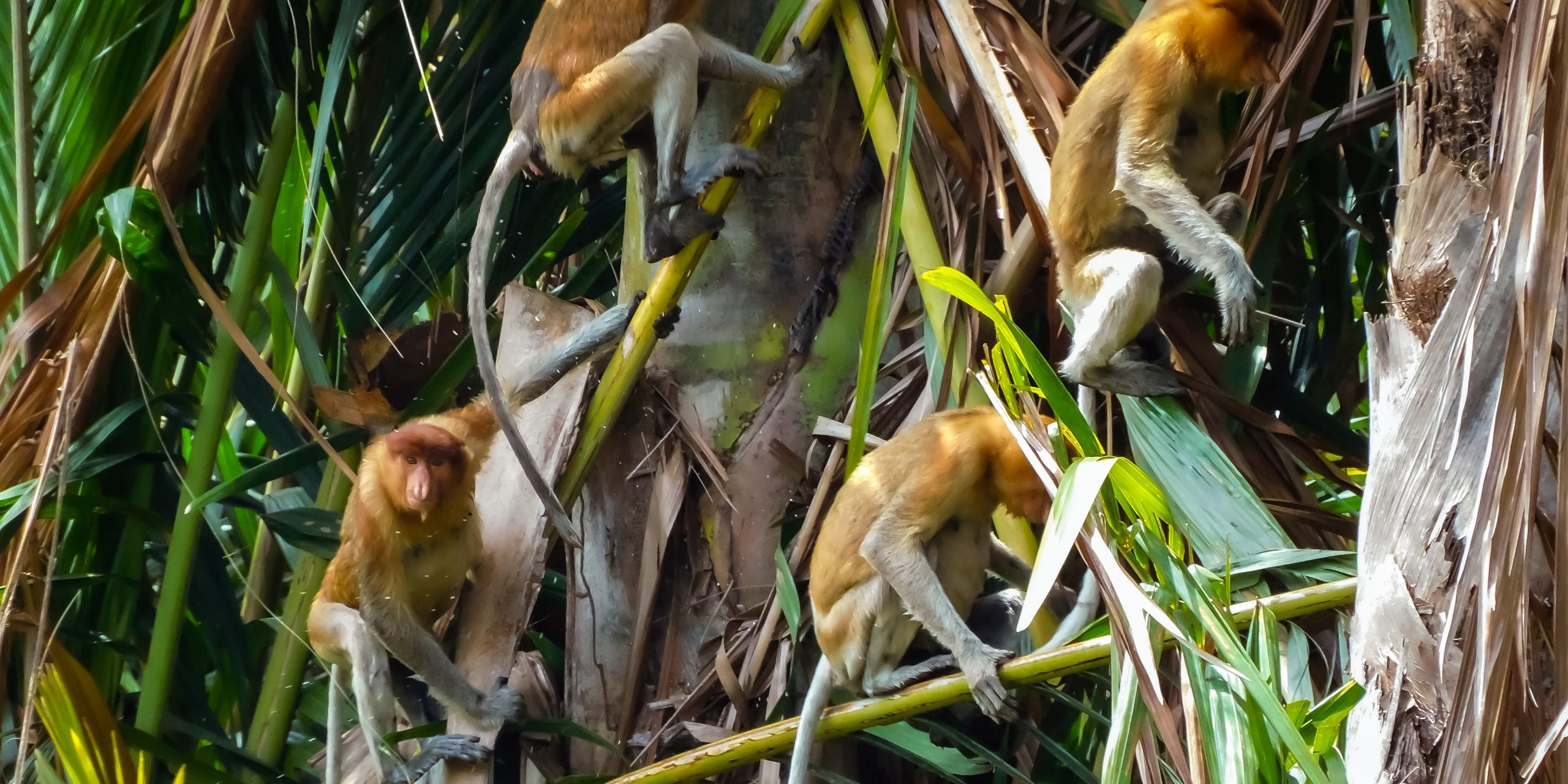
The proboscis monkey (Nasalis larvatus) is a primate native to the island of Kalimantan (Borneo) and can be identified by its special long nose; this remarkable animal is not only an iconic representation of Indonesia’s wildlife but also acts as a significant indicator of the condition of swamp forests, mangrove ecosystems, and riparian habitats.
Since they live in social groups, proboscis monkeys spend much of their time in the forest canopy. Their diet consists mainly of young leaves, fruits, seeds, and tender shoots, and the way they feed helps disperse seeds and promote natural forest regeneration. A notable feature of the species is its exceptional ability to swim. Because of their partially webbed feet, they can easily cross rivers, moving from one habitat to another, making them among the few primates adapted to aquatic environments.
The proboscis monkey is designated as a protected species by the Government of Indonesia’s Minister of Environment and Forestry Regulation No. P.106 of 2018. The species is also listed as Endangered on the IUCN Red List and appears in Appendix I of the Convention on International Trade in Endangered Species of Wild Fauna and Flora (CITES), which provides it with the highest degree of protection against international commercial trade.
Conserving Habitats to Protect the Proboscis Monkey
It is important to protect the natural habitat of the proboscis monkey if the species is to have a secure long-term future. A case in point is the conservation initiative being carried out by PT Agro Menara Rachmat (AMR), an Astra Agro affiliate in Central Kalimantan, which routinely monitors proboscis monkey populations in the company’s High Conservation Value (HCV) areas.
In 2025, population monitoring was carried out in swamp forest and riparian ecosystems using the concentration count method, a form of direct observation that focuses on areas of high wildlife activity.
The monitoring results showed that proboscis monkeys were still present at four separate observation sites, with groups of three to six animals at each site. The majority of the monkeys observed were adults, exhibiting normal behaviours such as moving through the canopy, leaping from tree to tree, and withdrawing when observers approached. Moreover, some of the animals were seen feeding on native tree species, such as Artocarpus spp.
The distribution of sightings across different locations suggests that the monkeys actively utilise swamp forest and riparian corridors as both movement routes and primary habitats. These findings indicate that PT AMR’s HCV areas continue to provide suitable habitat that supports healthy proboscis monkey populations, despite seasonal environmental dynamics such as flooding.
Protecting the Proboscis Monkey Means Protecting Ecosystem Balance
For Astra Agro, conservation does not stop at protecting a single species; it also involves protecting the entire ecosystem that supports a wide variety of plants and animals. The company’s commitment to this is evident in its integrated strategy for biodiversity conservation and climate action, based on Nature-based Solutions (NbS).
The company carries out a wide variety of initiatives, such as restoring ecosystems and reforestation, protecting natural ecosystems, and conserving key species including the proboscis monkey; by conserving keystone species Astra Agro also contributes to the preservation of the habitats which support a huge number of other plant and animal species in the same ecosystem.
In addition, Astra Agro conducts regular monitoring of wildlife populations and protects the natural food trees that support local fauna. These efforts not only help maintain healthy habitats but also generate broader environmental benefits, including enhanced carbon sequestration, reduced greenhouse gas (GHG) emissions, and greater landscape resilience in the face of climate change.
Biodiversity Continues to Grow
Astra Agro’s commitment to biodiversity is evident in the ongoing growth of its records in this area. When the historical monitoring data from 2022 to 2025 was compared, the company found that it had recorded 768 more species in 2025 than in the previous year. These newly recorded species include 665 plants, 20 mammals, 41 birds, 26 reptiles, and 16 amphibians.
This increase is largely attributable to the expansion of biodiversity monitoring beyond the company’s operational areas to include the surrounding landscape. At the same time, community participation through citizen science initiatives, discussions with local communities, and direct and indirect monitoring methods, including identifying animal tracks and other signs of wildlife presence, has significantly enriched the company’s biodiversity database.
For Astra Agro, protecting the proboscis monkey means safeguarding the balance of nature as a whole. The continued presence of this endemic species demonstrates that healthy habitats can sustain rich, diverse ecosystems. Through a landscape-based conservation approach and sustainable ecosystem management, Astra Agro’s sustainability initiatives are designed to ensure long-term ecological harmony. Together, we can help ensure that the proboscis monkey continues to leap freely through the forests of Kalimantan, inspiring biodiversity conservation for generations to come.