As the impacts of climate change become increasingly evident, businesses are expected not only to produce essential goods but also to deliver solutions that contribute to environmental sustainability. For Astra Agro, addressing this challenge goes beyond achieving emissions reduction targets—it is about redefining how the palm oil industry can operate more responsibly and sustainably.
One of the company’s key initiatives is implementing methane capture technology, an innovation that converts Palm Oil Mill Effluent (POME) into renewable energy. This technology captures methane, a potent greenhouse gas, before it is released into the atmosphere and instead repurposes it as a clean energy source to support mill operations.
Did You Know? Palm Oil Processing Residues Can Be Turned into Clean Energy
When people hear the term “waste,” they often think of something that must be discarded. In the palm oil industry, however, processing residues hold significant potential to support climate action. One of the most effective examples is methane capture technology.
What Is Methane?
Methane (CH₄) is one of the greenhouse gases that contribute to global warming. Although it exists in much lower concentrations than carbon dioxide (CO₂), methane has a significantly greater capacity to trap heat in the atmosphere.
According to the United Nations Framework Convention on Climate Change (UNFCCC), methane has a Global Warming Potential (GWP) approximately 21 times that of carbon dioxide over the assessment period in use at the time. This means that releasing methane into the atmosphere without proper management can have a far greater climate impact than emitting the same amount of CO₂.
Methane originates from both natural and human-related sources. Around 40% is produced naturally, primarily from wetlands. Today, however, most methane emissions are generated by human activities, including livestock farming, agriculture, landfills, and wastewater treatment processes across various industries, including palm oil production.
Why Does Palm Oil Mill Effluent Produce Methane?
During the production of crude palm oil, mills generate a liquid by-product known as Palm Oil Mill Effluent (POME).
POME is not classified as hazardous waste. It consists mainly of water and naturally occurring organic matter left over from processing fresh fruit bunches. As this organic material is treated in wastewater ponds, naturally occurring microorganisms break it down through anaerobic decomposition, a process that produces methane gas.
If this methane is released directly into the atmosphere, it becomes a significant source of greenhouse gas emissions and contributes to global warming.
What Is Methane Capture?
Simply put, methane capture is a technology that collects methane before it escapes into the atmosphere.
Instead of allowing methane to become an emission source, the gas is captured using covered anaerobic treatment ponds lined with impermeable materials such as High-Density Polyethylene (HDPE) or Polyvinyl Chloride (PVC). These covers trap the biogas generated during the decomposition of organic matter in POME.
The captured gas is then channelled to a treatment facility, where it is processed into biogas. This renewable energy can be used to fuel boilers, generate electricity, or supply other energy needs within the palm oil mill.
In essence, methane capture transforms what would otherwise become a source of greenhouse gas emissions into a valuable renewable energy resource, supporting both operational efficiency and the transition to a lower-carbon future.

Methane Capture: A Key Sustainability Innovation
For Astra Agro, methane capture is more than an investment in technology—it is an investment in the future. The initiative represents a key pillar of the company’s decarbonisation strategy and reflects its commitment to building a more efficient, low-carbon, and sustainable palm oil industry.
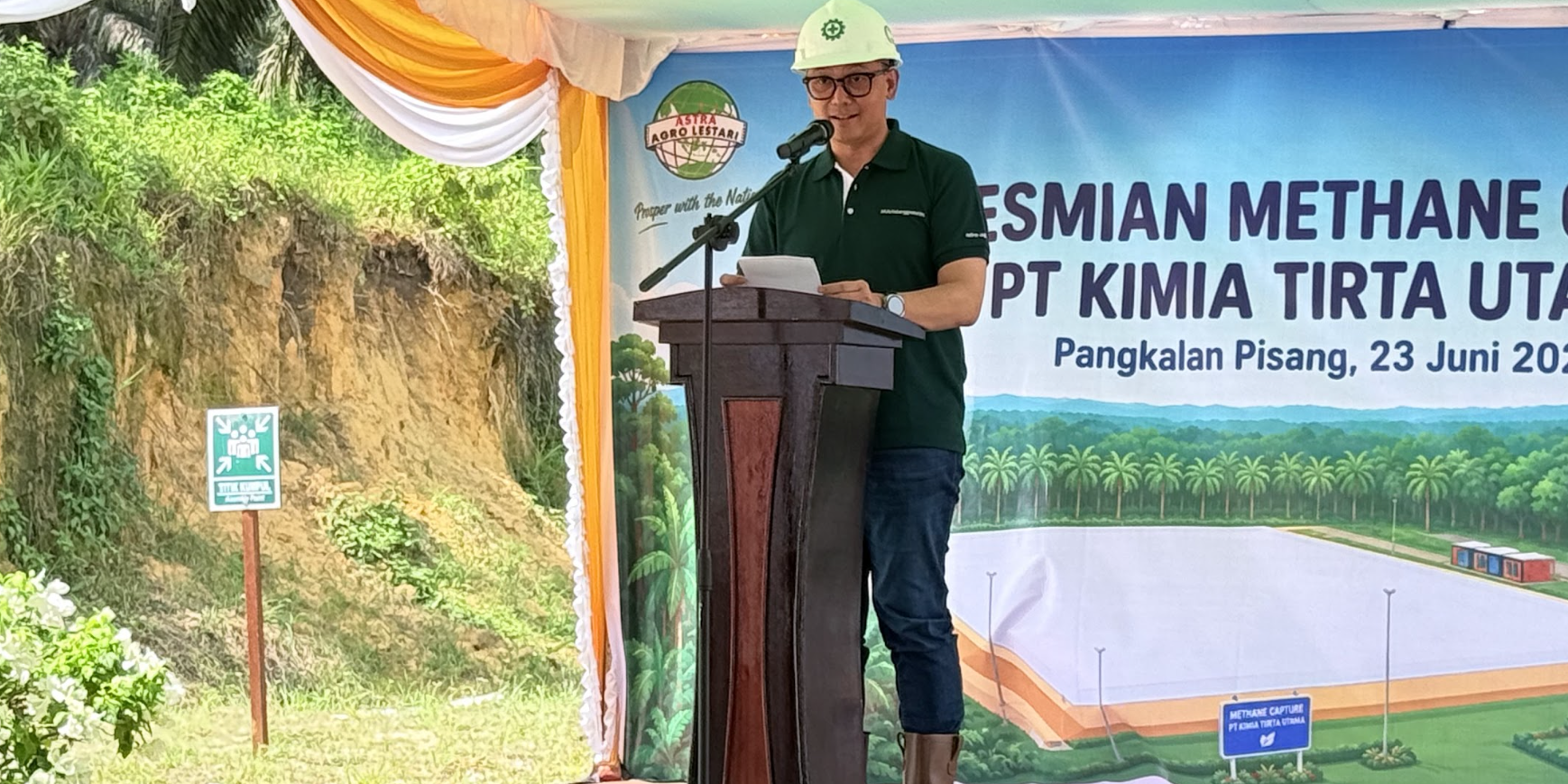
This commitment continues to take shape through the development of methane capture facilities across the company’s operations. One of the latest milestones is the inauguration of a methane capture facility at PT Kimia Tirta Utama (PT KTU), an Astra Agro subsidiary located in Siak Regency, Riau Province. The facility is the third methane-capture installation operating within Astra Agro’s Riau operations, further strengthening the company’s long-term emissions-reduction journey.
Behind the network of pipelines, wastewater treatment ponds, and biogas storage systems lies a simple yet powerful philosophy: the end of one process can become the beginning of another. Through innovation, what was once regarded as waste can be transformed into a valuable source of renewable energy, delivering lasting environmental and operational benefits.
With this facility, Palm Oil Mill Effluent (POME) is no longer viewed merely as a processing by-product. Instead, the methane generated during the natural decomposition process is captured, converted into biogas, and utilised as boiler fuel to support mill operations. In addition to significantly reducing greenhouse gas emissions, the use of biogas decreases reliance on biomass fuel, improving overall operational efficiency.
With a processing capacity of 50 tonnes of Fresh Fruit Bunches (FFB) per hour, the PT KTU methane capture facility had produced 1.17 million Nm³ of biogas as of May 2026. Of this total, 1.11 million Nm³ had been utilised as boiler fuel, replacing the use of palm kernel shells. These figures demonstrate the tangible contribution of renewable energy to the company’s operations.
The utilisation of biogas has reduced palm kernel shell consumption by 2,564 tonnes, equivalent to 3.5% of the total FFB processed through May 2026. The facility has also contributed to a reduction in emissions of 7,444 tonnes of CO₂ equivalent (CO₂e) as of May 2026 and is projected to achieve a total reduction of 28,649 tonnes of CO₂e by the end of 2026.
The PT KTU methane capture facility was officially inaugurated by Boy Kelana Soebroto, Chief of Corporate Affairs of PT Astra International Tbk, accompanied by Boy Gemino Kalauserang, Executive in Charge and Chief of Group Legal of Astra; Widayanto, Chief Technical Officer of Astra Agro; Bandung Sahari, Chief Agronomy & Sustainability Officer of Astra Agro; and Diah Suran Febrianti, Division Head of Environment, Social, and Responsibility (ESR) at Astra International. The inauguration was also attended by Astra Agro’s management and employees.
According to Boy Kelana Soebroto, the initiative forms part of Astra Agro’s commitment, as a subsidiary of Astra International, to implementing the Astra Agro Sustainability Aspirations 2030, which are aligned with the Astra 2030 Sustainability Aspirations. Reducing greenhouse gas emissions remains one of the company’s strategic priorities in supporting Indonesia’s transition towards a low-carbon economy.
The company’s sustainability journey has already delivered measurable results. Throughout 2025, Astra Agro reduced its greenhouse gas emissions by 439,000 tonnes of CO₂ equivalent, representing a 35.65% reduction compared with the 2019 baseline. This achievement reflects the combined impact of multiple integrated initiatives, including the utilisation of processing residues as fertiliser and renewable energy, improved fuel efficiency, enhanced operational performance, and the expansion of methane capture facilities.
Looking ahead, Astra Agro plans to progressively develop 10 methane capture facilities across its operational units. Once fully operational, these facilities are projected to contribute a total emissions reduction of 357,660 tonnes of CO₂ equivalent by 2030, further strengthening the company’s contribution to Indonesia’s Net Zero Emissions ambition while advancing a more sustainable palm oil industry.