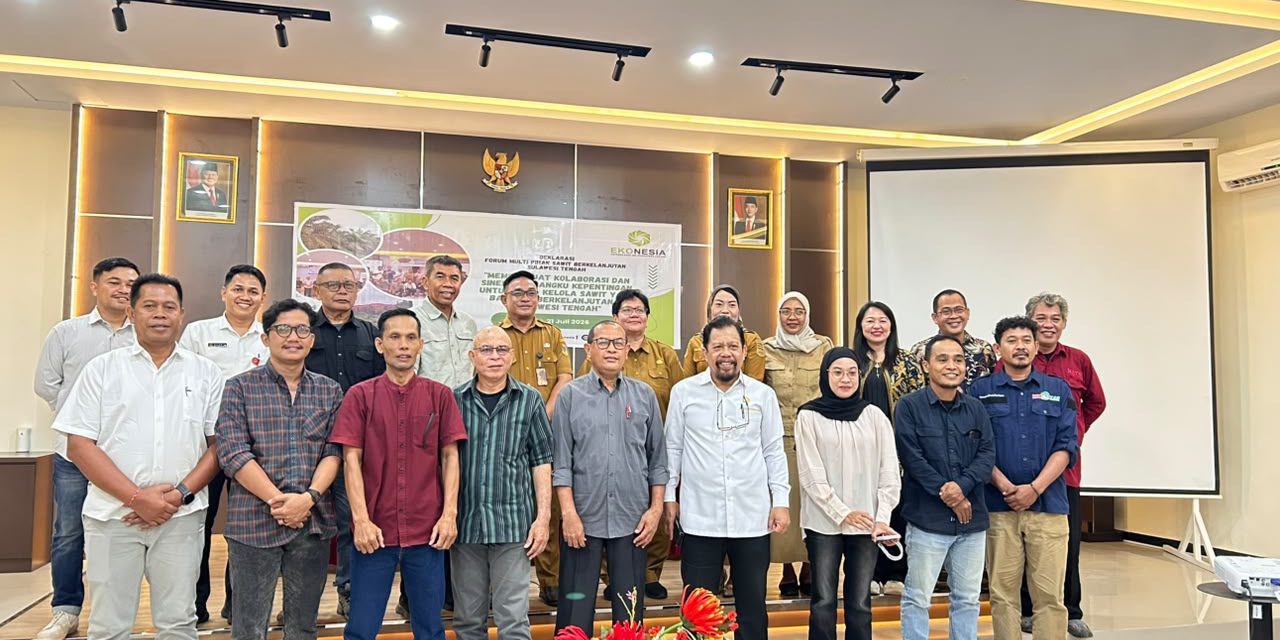
MAKASSAR – The Central Sulawesi Sustainable Palm Oil Multi-Stakeholder Forum (FMPSB-Sulteng) was officially established on 21 July. The forum serves as a platform for communication, coordination, and collaboration among key stakeholders to strengthen governance of sustainable oil palm plantations across Central Sulawesi Province.
The forum was initiated by local Civil Society Organisations (CSOs) and Non-Governmental Organizations (NGOs) to foster stronger collaboration among government institutions, the private sector, smallholder farmers, academia, civil society organisations, and development partners to accelerate improvements in sustainable palm oil governance in the province.
Ir. H. Musliman, MM, Member of Commission III of the Central Sulawesi Provincial House of Representatives (DPRD), expressed his hope that the forum would become more than a platform for exchanging ideas, but would also deliver tangible breakthroughs that contribute to the province’s development.
“We expect this forum to generate meaningful breakthroughs for the palm oil sector in Central Sulawesi. Collaboration among all stakeholders is the key. Together, we can advance the sustainable development of the palm oil industry in our province,” he said.
Palm oil remains one of Indonesia’s most valuable export commodities, generating about US$20–27.75 billion in annual export earnings and contributing around 12% of the country’s non-oil and gas exports. The industry accounts for about 1.6% of Indonesia’s Gross Domestic Product (GDP), contributes tens of trillions of rupiah in tax revenues, and provides direct employment for more than 4.5 million people.
Echoing this view, Jen Kurnia Gembu, HeadEchoing this view, Jen Kurnia Gembu, Head of the Legal Division of the Central Sulawesi Provincial Secretariat, expressed strong support for the forum’s establishment. He said the initiative is a strategic step to strengthen assistance in addressing challenges within the palm oil sector and ensure its long-term sustainability.addressed, ranging from regulatory frameworks and governance to operational challenges in the field. Therefore, stronger collaboration among stakeholders is essential to delivering sustainable and practical solutions.
“In principle, the Legal Bureau of the Central Sulawesi Provincial Secretariat fully supports the establishment of the Sustainable Palm Oil Multi-Stakeholder Forum. Many challenges within the palm oil sector require coordinated support to ensure sustainable management,” he stated.
He emphasised that the government plays a pivotal role in coordinating stakeholders and providing legal certainty and supportive policies that enable sustainable palm oil governance.
“The government’s role is crucial in coordinating all stakeholders so that challenges can be resolved collaboratively and sustainable palm oil development in Central Sulawesi can be achieved,” he added.
Collaboration as the Foundation of Sustainable Development
Prof. Mohamad Ahlis Djirimu, an academic from Tadulako University in Palu, highlighted that collaboration among all stakeholders is fundamental to building a sustainable palm oil industry.
“We must strengthen synergy among corporations, provincial and local governments. Without collaboration, we will not be able to maximise the benefits generated by the palm oil industry,” he explained.
According to Prof. Djirimu, downstream development of the palm oil industry in Central Sulawesi faces challenges because much of the processing capacity is outside the province. Transporting Fresh Fruit Bunches (FFB) from several production areas is less efficient due to longer distances.
In evaluating the 2030 Sustainable Development Goals (SDGs), he stressed that the future development of the palm oil industry should continue to uphold sustainability principles by protecting both workers and the environment.
“Workers’ rights must be safeguarded, freedom of association must be respected, and we must continue promoting inclusivity, particularly the protection of women workers’ rights. Global expectations will increasingly focus on sustainability issues,” he said.
A Platform for Dialogue and Sustainable Solutions
Azmi Sirajudin, Executive Director of Ekonesia, described the establishment of the forum as an important milestone in creating a collaborative platform that brings together diverse stakeholders to advance sustainable palm oil development in Central Sulawesi.
“We hope this forum will become a shared platform for strengthening communication, enhancing coordination, and fostering collaboration among all stakeholders so that palm oil governance in Central Sulawesi becomes more sustainable, more effective, and delivers greater benefits for local communities,” he said.
Azmi explained that the forum aligns with the Central Sulawesi Provincial Government’s vision of achieving prosperous, equitable, advanced, and sustainable development through its Nine BERANI development agenda, particularly the ‘BERANI Makmur’ (Prosperity) mission.
The forum will perform several strategic functions, including strengthening the capacity of independent smallholders to adopt sustainable plantation practices, facilitating dialogue among stakeholders, and supporting conflict resolution where necessary.
In addition, the forum will act as a catalyst for greater stakeholder participation in sustainable plantation management while accelerating the achievement of national strategic priorities, including the Smallholder Palm Oil Replanting Programme (PSR), implementation of the Indonesian Sustainable Palm Oil (ISPO) standard, downstream industry development, and the transition towards a palm oil sector that is deforestation-free, environmentally responsible, and respectful of human rights.
“Through this forum, we want to ensure that every stakeholder has a platform to engage in dialogue, develop solutions together, and support the implementation of sustainable palm oil in Central Sulawesi. Collaboration is the key to creating an inclusive, competitive, and sustainable palm oil industry,” Azmi concluded.
The establishment of the Central Sulawesi Sustainable Palm Oil Multi-Stakeholder Forum is expected to strengthen collaboration among all stakeholders while supporting the achievement of sustainable palm oil development goals across Central Sulawesi Province.
Source: Antara News
Disclaimer
This article may contain copyrighted material, the use of which may not have been pre-authorized by the copyright owner. This material is made available for the purpose of giving information and knowledge. The material contained on the Astra Agro website distributed without profit. If you are interested in using copyrighted material from this material for any reason that goes beyond ‘fair use’, you must first obtain permission from the original source