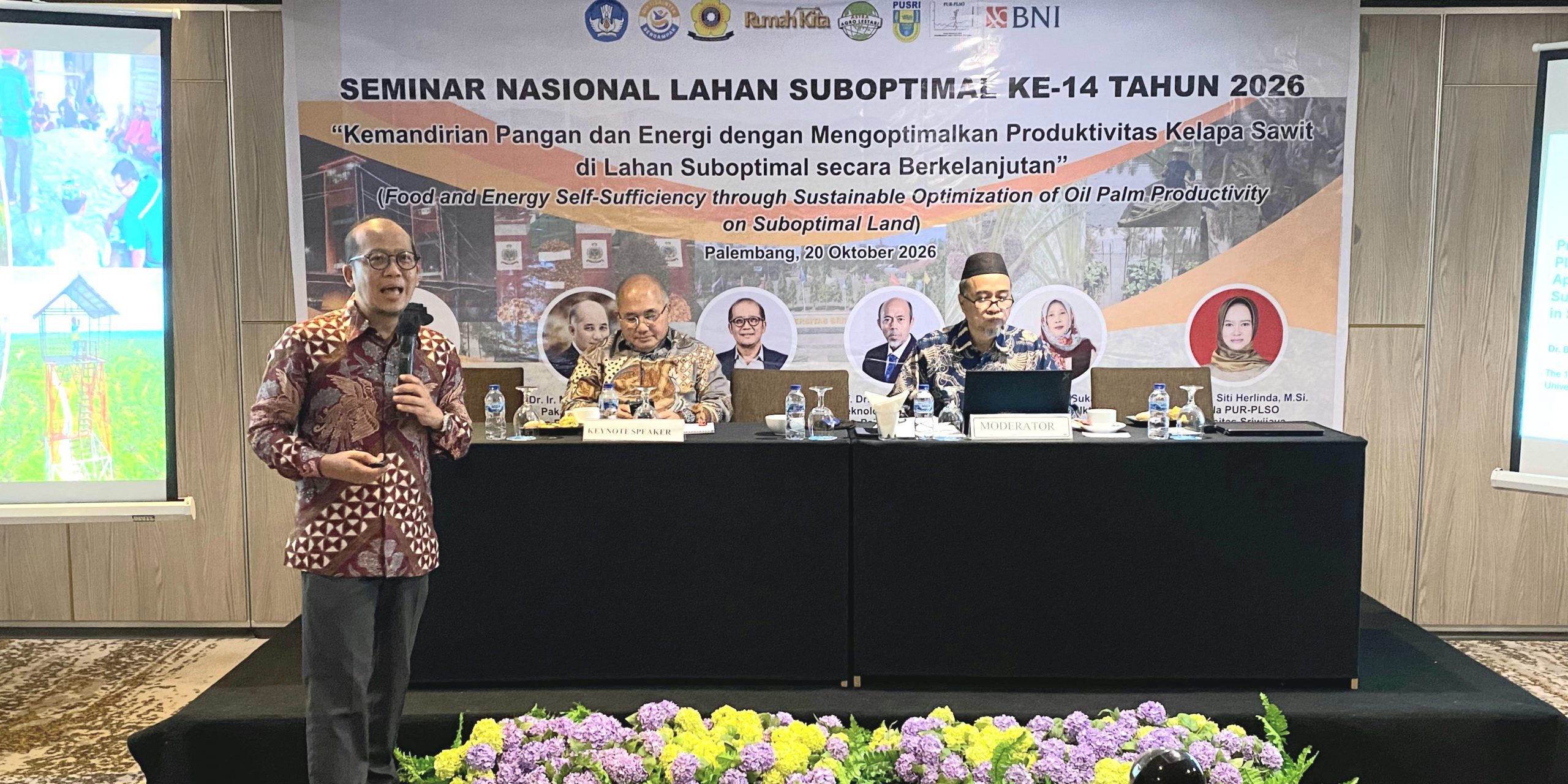
PALEMBANG (ANTARA) – PT Astra Agro Lestari Tbk (AALI) has implemented four strategies to optimize oil palm productivity on suboptimal land: the use of superior planting materials, soil ameliorant application, soil improvement through biofertilizers, and optimal water management systems. These approaches are tailored to the characteristics of each land type to enhance plantation productivity while maintaining environmental sustainability.
The strategies were presented by Dr. Bandung Sahari, Director of Agronomy and Sustainability at PT Astra Agro Lestari Tbk, as one of the keynote speakers at the 14th National Seminar on Suboptimal Land 2026, organized by Sriwijaya University (Unsri) on Tuesday, October 20, 2026. The seminar, themed “Achieving Food and Energy Self-Sufficiency by Sustainably Optimizing Oil Palm Productivity on Suboptimal Land,” was attended by participants both in person and online from various regions across Indonesia.
In his presentation, Bandung emphasized the importance of a site-specific plantation management approach. This approach recognizes that each land type has distinct characteristics and limiting factors, requiring tailored cultivation strategies. Accordingly, productivity improvements should not rely solely on increased inputs, but also on the effective management of soil, crops, and water resources.
“Efforts to increase oil palm productivity should focus on optimizing land that is already under cultivation, particularly as global demand for vegetable oils continues to rise while land availability remains limited. The key lies in implementing strategies that match the characteristics of each land type, ranging from selecting superior planting materials and improving soil conditions to utilizing biofertilizers and implementing appropriate water management practices. A site-specific approach creates opportunities to enhance productivity more efficiently and sustainably,” said Bandung.
Prof. Dr. Ir. Siti Herlinda, M.Si., Head of the Center of Excellence for Suboptimal Land Development Research (PUR-PLSO) at Sriwijaya University, noted that oil palm is one of Indonesia’s leading commodities, offering wide-ranging benefits and playing an important role in meeting vegetable oil demand. Therefore, improving productivity through the optimization of suboptimal land is a strategic effort to maintain the sustainability of the plantation sector.
“Oil palm is one of Indonesia’s leading commodities, offering significant benefits. The challenge lies in how to improve productivity sustainably, including by optimizing the potential of suboptimal land. This requires an approach based on land characteristics, supported by the use of superior planting materials, improved soil quality, biofertilizer application, and proper water management,” she said.
According to Herlinda, collaboration between universities and industry is essential to translating research findings into practical approaches that address field requirements. Knowledge exchange between academics and industry practitioners also creates opportunities to develop agronomic innovations that enhance productivity while taking environmental carrying capacity into account and supporting sustainable agriculture.
Suboptimal land refers to areas with physical, chemical, or environmental limitations that result in relatively low natural productivity. These areas include drylands, inland swamps, tidal lowlands, and peatlands. Given their varying characteristics, these land types cannot be managed using a uniform approach. Instead, management strategies must begin with identifying the specific limiting factors at each location.
On peatlands and tidal lowlands, for example, water management is particularly important. Regulating groundwater levels through infrastructure such as water gates, drainage channels, pump houses, and piezometers helps maintain water availability for crops. Proper water management is also essential to mitigating environmental risks, including organic matter oxidation, land subsidence, and fires.
For Astra Agro, optimizing suboptimal land is also closely linked to strengthening agronomic research and development, including the development of superior planting materials to improve productivity and cultivation efficiency. Innovations in planting materials must be supported by appropriate soil, nutrient, and water management to fully realize their potential.
Efforts to strengthen planting material quality are also carried out through Astra Agro’s subsidiary, PT Gunung Sejahtera Ibu Pertiwi, which has obtained SNI ISO 9001:2015 Quality Management System certification from PT TÜV NORD Indonesia. The certification covers seed research and production processes, ranging from research and breeding to the production and marketing of oil palm sprouts.
This approach aligns with Astra Agro’s Sustainability Aspirations 2030, which encompasses various sustainability initiatives under its Triple-P Roadmap: Portfolio, People, and Public Contribution, with Good Corporate Governance (GCG) serving as a key enabler. Within this framework, productivity goes hand in hand with environmental management, human capacity development, community contributions, and responsible corporate governance.
Through sustainable intensification, Astra Agro views suboptimal land not merely as an agronomic challenge, but also as an opportunity to optimize land already under cultivation in a more productive and responsible manner. Supported by research, innovation, and site-specific management practices, land optimization is expected to contribute to national oil palm productivity while strengthening food and energy security sustainably.
Source: Antaranews.com