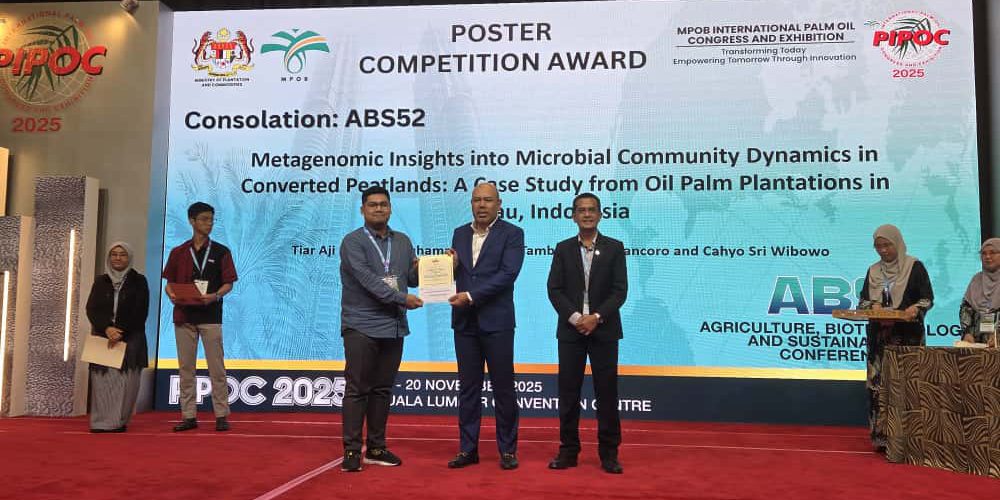
Kuala Lumpur – PT Astra Agro Lestari Tbk (Astra Agro) has once again achieved international recognition with its Research and Development (R&D) team winning the Consolation Prize in the Best Poster Competition at the Agriculture, Biotechnology and Sustainability (ABS) conference. This competition is part of the main series of the MPOB International Palm Oil Congress and Exhibition (PIPOC) 2025, which will take place from November 18 to 20, 2025, at the Kuala Lumpur Convention Centre.
This award carries significant prestige because PIPOC is a global biennial congress directly organized by the Malaysian Palm Oil Board (MPOB). Judging was carried out by as many as 31 judges, who are leading academic experts and industry practitioners. The credibility of these judges makes the poster competition at PIPOC one of the most competitive scientific events in the global palm oil industry.
The poster that led Astra Agro to win the award was titled “Metagenomic Insights into Microbial Community Dynamics in Converted Peatlands: A Case Study from Oil Palm Plantations in Riau, Indonesia.” The presented material highlights the use of Metagenomic Profiling technology to understand the dynamics of microbial communities in peatlands with varying levels of productivity.
Astra Agro Lestari Senior Vice President of Research and Development, Cahyo Wibowo, stated that this metagenomic research is an important element of the company’s innovation roadmap. Astra Agro had previously successfully developed Astemic, a biofertilizer for mineral soils, which has been used on approximately 50,000 hectares, resulting in chemical fertilizer use efficiency reaching 25 percent.
According to him, this success serves as a foundation for the company to expand its exploration to unique lands such as peat, brackish, and acid sulfate. “Peatlands have very different microbial characteristics and require a more precise scientific approach. Through this research, we mapped the dominant microbial communities and their functions, providing a basis for developing new, more adaptive bio-inputs. This is part of our strategy toward developing peat-specific biofertilizers,” said Cahyo.
These development efforts were then strengthened thru the use of Metagenomic Profiling, a method that analyzes total DNA from soil microbes without cultivation, providing a comprehensive overview of microbial diversity and function while opening opportunities for identifying superior microorganisms that play a role in increasing the availability of essential nutrients such as Phosphate P and Potassium K. These findings serve as an important basis for peat conservation strategies, emission mitigation, and fertilizer optimization in sensitive ecosystems.
Reinforcing these results, Tiar Aji Saputra, Microbiology Junior Expert at Astra Agro Lestari and team leader, stated that the achievement serves as a significant validation of the research direction currently being pursued by Astra Agro. “This award shows that the metagenomic approach is not only scientifically relevant but also strategic for the future management of peatlands. Our findings provide a strong foundation for designing more effective nutritional solutions for peatlands. This is an important initial step toward Astra Agro’s target of producing peat-specific biofertilizers,” said Tiar.
The ABS conference, where the work was presented, is one of four major conferences at PIPOC designed to bring together experts, researchers, academics, companies, and policymakers from around the world. This year, PIPOC is hosting over 1000 participants, 100 speakers, 200 poster presenters, and more than 400 exhibitors. This event is held biennially as a global forum to showcase the latest technologies, publish research advancements, and build innovation-based collaborations under the overarching theme “Transforming Today, Empowering Tomorrow Through Innovation.”
This achievement underscores Astra Agro’s commitment to strengthening biotechnology-based research as the foundation of sustainable agricultural practices. This success also demonstrates that scientific innovation can be combined with efforts to increase productivity while conserving the peatland ecosystem, a crucial component of the plantation landscape in Indonesia. (*)